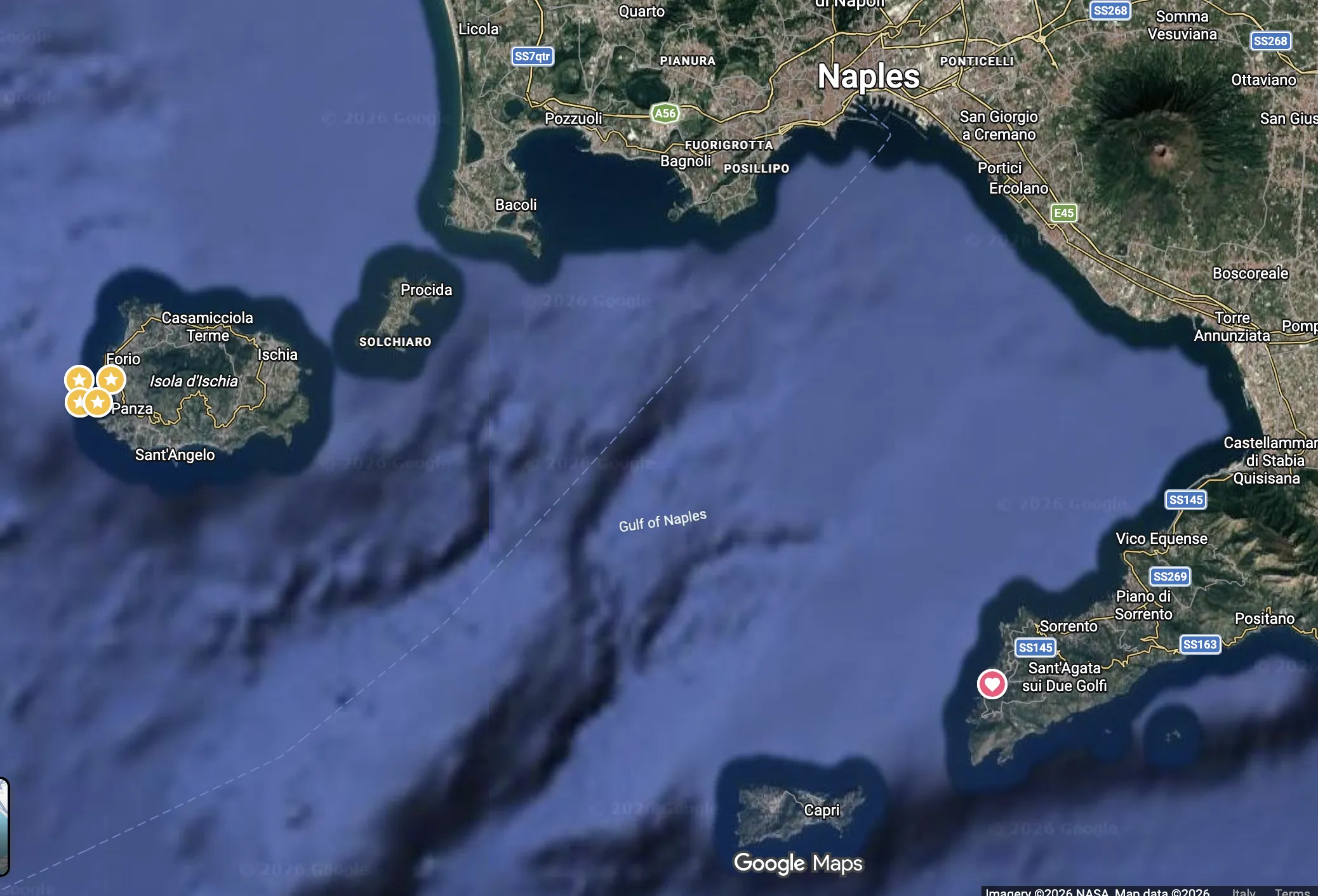
Everything you need to know about spearfishing in Naples, Italy: the best spots around the Gulf of Naples, how to get your fishing license, beginner courses, essential equipment, and safety rules — all from a local expert who has spent thousands of hours underwater in these waters.
Why Naples is a World-Class Spearfishing Destination
Stretching from the volcanic shores of the Campi Flegrei to the dramatic cliffs of the Sorrento Peninsula, the Gulf of Naples is one of the richest marine environments in the entire Mediterranean. The seabed here is shaped by ancient volcanism — fields of rocky reef, underwater caves, and nutrient-rich currents that support an extraordinary range of fish species year-round.
Visibility regularly exceeds 15–20 metres during spring and early autumn, water temperatures are comfortable from May through October, and the proximity of the islands of Ischia and Procida adds even more habitat diversity within easy reach. Whether you arrive by boat or jump off a rocky shore, there is almost always somewhere productive to dive.
My name is Simone Ruggiero. I grew up on the Neapolitan coast and have been spearfishing these waters since I was a teenager. Over the years I have mapped spots from Nisida to the Punta Campanella marine reserve, dived in every season, and guided hundreds of beginners and experienced spearos. This guide distils that local knowledge so you can make the most of your time in the water.
Best Spearfishing Spots near Naples
The Gulf offers a wide variety of dive sites. Here are the most productive and most accessible — from calm, shallow entries for beginners to offshore reefs for advanced divers.
Nisida
Just a short drive from central Naples, the small volcanic island of Nisida sits inside the Campi Flegrei arc and is connected to the mainland by a causeway. The rocky coastline on its western and southern faces drops from 3 to 20 metres over a mix of boulders, sandy patches, and small caves. It is one of the most accessible shore-entry spots around Naples and a great place for beginners to get their first feel for Mediterranean spearfishing.
- Depths: 3–20 m
- Target species: White seabream (sarago), mullet, octopus, wrasse
- Access: Shore entry from the rocky shoreline
- Best for: Beginners and intermediate divers
Local tip: Early-morning weekday sessions before the traffic builds up reward you with calmer water, better visibility, and far more active fish.
Ischia Island
Ischia's volcanic origins have created some of the most dramatic underwater topography in the Gulf — lava walls, thermal vents, deep fissures, and extensive fields of Posidonia seagrass. Marine life here is genuinely impressive: large grouper, moray eels, dentex, and seasonal amberjack all call these waters home. The downside is that the vast majority of the island falls within the Regno di Nettuno marine protected area, where spearfishing is strictly prohibited.
- Permitted fishing area: A limited zone near Forio on the western coast
- Depths: 5–35 m
- Target species: Grouper, dentex, sarago, octopus
- Best season: May–October
Important: Always verify the exact boundaries of the protected zone before diving. Fines for spearfishing inside the MPA are substantial.
Procida
Italy's smallest inhabited island is a short ferry ride from Naples and has a character all its own — pastel-coloured houses, quiet harbours, and relatively protected waters on its leeward side. Like Ischia, most of Procida is within a marine reserve, but the permitted fishing area near the cemetery provides calm, sheltered conditions with good fish populations. It is a solid choice for beginners who want a relaxed environment to practise breath-hold and buoyancy without strong currents.
- Permitted area: Zone near the Procida cemetery
- Depths: 4–18 m
- Target species: Sarago, mullet, sea bass, octopus
- Best for: Beginners, calm-water practice
Banco di Santa Croce
This offshore seamount, located between Ischia and the Sorrento Peninsula, is the kind of spot that advanced spearos dream about. The top of the bank sits at around 25–30 metres and drops away steeply on all sides, creating a natural aggregation point for large pelagic fish. Amberjack, dentex, and even bluefin tuna pass through during migration season. A boat is essential, conditions can change quickly, and only experienced breath-hold divers should attempt it.
- Depths: 25–50 m+
- Target species: Amberjack (ricciola), dentex, large grouper, tuna (seasonal)
- Access: Boat only
- Level: Advanced — experienced divers only
- Best season: June–October
Safety note: Never attempt an offshore bank without a dedicated safety boat, a trained buddy, and a clearly visible surface marker buoy. Depths and currents here are not forgiving of mistakes.
Sorrento Peninsula / Punta Campanella
The rocky northern coast of the Sorrento Peninsula — from Vico Equense down to Massa Lubrense — offers kilometres of productive reef with depths from 5 to 35 metres. The very tip of the peninsula, Punta Campanella, is a marine protected area; however, buffer zones adjacent to the reserve still allow fishing with the correct documentation. The rocky walls and current-washed points attract dentex, grouper, amberjack, and large seabream. This is some of the best diving within reach of Naples.
- Depths: 5–35 m
- Target species: Dentex, grouper, amberjack, large sarago
- Best season: May–October
- Note: Verify MPA buffer-zone regulations before each session
What Fish Can You Catch?
The Gulf of Naples hosts an impressive variety of Mediterranean species. Here are the most common targets and when to expect them.
- Sea bass / Spigola — Present year-round; most active around rocky structures and kelp edges in spring and autumn. A classic beginner target.
- Sea bream / Orata & Sarago — Orata (gilt-head bream) likes sandy bottoms and Posidonia meadows; sarago (white seabream) prefers rocky reef. Both available throughout the year, peak autumn.
- Amberjack / Ricciola — Seasonal pelagic; arrives in the Gulf from May, peaks in September–October. Fast, powerful, and one of the most prized catches.
- Grouper / Cernia — Cave-dwelling ambush predator. Present all year but more visible in summer. Requires patience and a good knowledge of the seabed.
- Dentex / Dentice — Mid-water predator found over rocky drop-offs, mainly May–October. Wary and fast; rewarding for experienced hunters.
- Octopus / Polpo — Excellent autumn and winter target when other fish slow down. Found in almost every rocky crevice at shallow to medium depths.
- Mullet / Cefalo — Common inshore species; shoals in harbours, bays, and river mouths year-round. Good practice for stealth technique.
Spearfishing License in Italy: What You Need
Before you get in the water with a speargun, you need to sort out the legal requirements. The good news is the process is straightforward.
- Minimum age: 16 years old. Under-18s may also need parental consent depending on the specific licence category.
- Fishing licence (Licenza di pesca): Issued by the local Capitaneria di Porto (Harbour Master's office). Bring a valid ID, passport photos, and the small administration fee. The licence is valid nationwide.
- Medical certificate: A certificate of fitness for underwater sports activities (idoneità alla pratica di attività subacquee) from a certified sports doctor. Valid for one year.
Key rules to keep in mind at all times:
- Stay at least 200 metres from designated swimming beaches during the bathing season
- Stay at least 100 metres from anchored or moored vessels
- No SCUBA gear — spearfishing on breath-hold only, by law
- No night spearfishing — prohibited from sunset to sunrise
- A surface marker buoy (boa segnasub) must be deployed whenever you are in the water
- Minimum landing sizes apply for all species — check the current MIPAAF tables
- Respect all marine protected area boundaries — penalties are severe
Pro tip: If you join one of my guided sessions or courses, I walk you through all the paperwork and regulations in person before your first dive. No nasty surprises.
Best Time to Go Spearfishing in Naples
The Gulf of Naples is fishable for most of the year, but each season has its own character.
- Spring (April–June) — Best for visibility and variety. Water warms from around 15 °C to 22 °C, plankton blooms settle down, and visibility peaks at 15–25 metres. Seabream are active and spawning, sea bass patrol the rocky edges, and the first amberjack and dentex start to appear in May–June. This is the ideal window for beginners to learn.
- Summer (July–August) — Warm water, heavy traffic. Surface temperatures reach 25–27 °C and the water is very comfortable to dive in. Visibility stays good. The downside is tourist boat traffic — weekends especially can make shore-entry spots unusable. Weekday early-morning sessions are the solution.
- Autumn (September–October) — Prime season for big fish. Many experienced spearos consider this the best period. Amberjack shoals are at their largest, dentex and grouper are feeding hard before winter, and boat traffic drops significantly after September. Water is still warm (22–24 °C) and visibility is excellent.
- Winter (November–March) — Cold but not impossible. A 7 mm wetsuit (or drysuit) is essential as water drops to 14–16 °C. Fish behaviour changes — most species move deeper or become sluggish — but octopus and sarago hunting can still be very productive. Far fewer divers in the water means undisturbed spots and a real sense of solitude.
Courses & Guided Dives in Naples
If you are new to spearfishing — or simply want to improve your technique and discover the best local spots — a structured course is the fastest and safest way to progress.
I offer beginner and intermediate spearfishing courses in the Gulf of Naples, designed for both complete newcomers and swimmers who already have some underwater experience. Sessions cover:
- Breath-hold technique and safe equalisation
- Buoyancy control and duck-diving
- Speargun handling, loading, and safe use
- Hunting strategies for different species and terrain
- Italian regulations and best practices
- Emergency procedures and buddy system
All equipment is provided. Sessions run year-round, weather permitting, and can be adapted to your schedule. Small groups (maximum 4 people) mean plenty of personal attention.
Not sure which course is right for you? Get in touch through the courses page and I will help you choose the best option based on your experience level and goals.
Essential Spearfishing Equipment
You do not need to spend a fortune to get started, but having the right gear makes a significant difference to both safety and success. Here is a quick overview — see the full equipment guide for detailed recommendations.
- Speargun: A 75–90 cm rubber-powered speargun is ideal for beginners in the Gulf of Naples. It is long enough to reach fish at a reasonable range but short enough to manoeuvre through rocky terrain. Pneumatic guns are an alternative, but rubber guns are simpler to maintain.
- Wetsuit: 5 mm open-cell for summer and a 7 mm (or 5 mm + hood and gloves) for winter. Mediterranean water is deceptively cold — a proper wetsuit also helps with buoyancy control.
- Mask: Low-volume freediving mask for easy equalisation and a wide field of view. Avoid cheap snorkelling masks with large internal volumes.
- Fins: Long blade freediving fins (fibreglass or carbon) for efficient, low-effort propulsion. Foot pocket fit is critical — try before you buy.
- Weight belt: Rubber belt with quick-release buckle. Work with a qualified instructor to find the right amount of weight for neutral buoyancy at depth.
- Surface marker buoy (float): Mandatory by Italian law and a genuine life-saver. Attach a dive flag and always deploy it before you dive.
Safety Tips for Spearfishing in Naples
Spearfishing is a low-risk activity when done correctly — but the risks are serious when basic safety rules are ignored. Please take these points seriously.
- Never dive alone. Shallow-water blackout (loss of consciousness on ascent due to hypoxia) is the leading cause of spearfishing fatalities worldwide. It happens without warning. A trained buddy who is watching you at all times is the only reliable protection.
- The buddy system — one up, one down. While one person dives, the other watches from the surface. Do not both descend at the same time.
- Deploy your surface marker buoy before every dive. It signals your position to passing boats and is required by Italian law. Use a brightly coloured buoy with a dive flag.
- Know your limits. Do not push your breath-hold time to the absolute maximum. End every dive with a comfortable reserve — if you feel the urge to breathe urgently underwater, you have already gone too far.
- Rest between dives. Rest at the surface for at least twice the duration of your dive before descending again. Rushing recovery is a fast way to trigger blackout.
- Check conditions before entering. The Gulf of Naples can produce sudden wind and sea changes, particularly in autumn and winter. Check the marine forecast (Meteo Mare) and never enter the water if conditions are deteriorating.
- Emergency contacts: The Italian maritime emergency number is 1530 (Guardia Costiera). Save it in your phone before every session.
Bottom line on safety: Every experienced spearo I know has a story about a close call — usually their own or a buddy's. The rules above are not optional. If you are new, please do your first dives with a qualified instructor. It is not just about catching fish; it is about coming home.
Ready to Dive?
The Gulf of Naples is waiting. Whether you want to join a beginner course to learn the fundamentals safely, or you are an experienced spearo looking to explore new spots with a local guide, get in touch and we will find the right session for you.
Check the equipment guide for detailed gear advice, browse the rest of the blog for more technique articles, and feel free to reach out with any questions. See you underwater.
Want to see the Gulf of Naples underwater?
My YouTube channel has real footage from dives around Naples, Capri, Ischia, and the Sorrento Peninsula — catches, techniques, and honest tips from the water.
Visit my YouTube channel