A complete guide to getting started with spearfishing: essential equipment, basic techniques, safety and practical tips for those starting from scratch.
Rule #1: TAKE A FREEDIVING COURSE
Knowing the basics of spearfishing is essential to start safely. A freediving course will give you the basic theoretical and practical skills, such as breathing, flexibility and stress management, but above all it will teach you to know your body and its limits.
Spearfishing is a fascinating activity that combines sport, nature and skill. For anyone approaching this world for the first time it can seem complex, but with the right advice and the right preparation, anyone can start practising it safely.
Equipment
Before you get in the water, it is essential to have the right equipment. Here is what you need to get started:
Mask and Snorkel
Choosing the mask and snorkel is very important. The mask must fit your face perfectly and offer a good field of view. There are many masks on the market, and finding the right one for you will certainly not be easy.
The snorkel should be simple and of medium stiffness, neither too hard nor too soft. It must let you breathe without effort, and a snorkel that is too soft collapses and won't let you breathe.
Fins
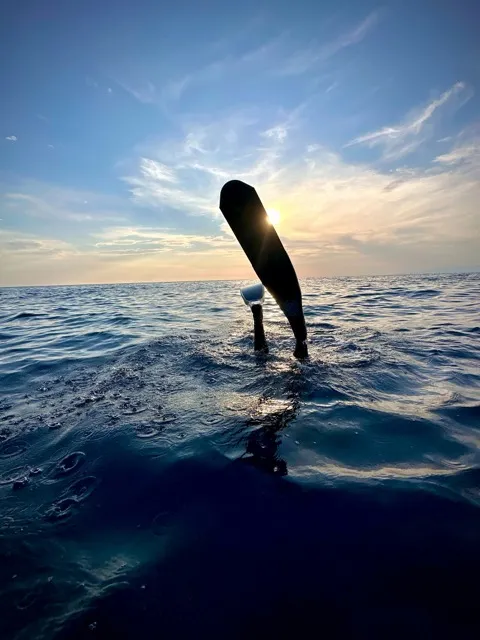
For beginners, fins made of technopolymer (plastic) are recommended, preferably with a removable foot pocket so that one day you can replace the blade with a carbon one. Personally I use the Mares Razor, a model that is not too light but extremely durable and compatible with most blades on the market.
The Wetsuit
If you start spearfishing in summer, a 5 mm jacket and 3 mm trousers will be enough, since the water will be between 25 and 29 degrees (Celsius). In winter things get harder, and for most beginners a jacket of at least 7 mm and trousers of at least 5 mm are recommended. Personally I use an 8 mm jacket and 7 mm trousers in open-cell smooth-skin neoprene.
Weight Belt
Choosing the right ballast is essential. It depends on many factors: your body density, your wetsuit, the depths you fish. It goes without saying that in shallow water you will need a lot of kilos on the belt; you can also use a back weight to avoid straining the lower back too much.
Speargun
For beginners a medium-length (75-90cm) arbalete-style speargun is recommended: inexpensive, easy to handle and to load. A gun of this size can be used both for ambush hunting and for waiting hunting (aspetto), in shallow water or in deeper waters too.
Basic Breathing Techniques
Breathing is the most important aspect of spearfishing:
- Practise diaphragmatic breathing
- Learn to relax in the water
- Do not hyperventilate before diving
- Always respect your limits
Safety: The Absolute Priority
Rule #2: Never Freedive Alone
Always go spearfishing with an experienced partner who can assist you if needed.
Other fundamental safety rules:
- Always use a signalling buoy
- Know the warning signs (dizziness, blurred vision)
- Find out about currents and sea conditions
- Respect local fishing regulations
Respect for the Marine Environment
Spearfishing must be practised with deep respect for the marine ecosystem:
- Respect minimum fish sizes
- Do not exceed 5 kg of catch (per person)
- Do not damage the seabed and marine plants
- Pick up any rubbish you find in the sea
Conclusion
Starting spearfishing takes patience and dedication, but the results more than repay the effort. Always remember that safety comes first and that respect for the sea is fundamental.
With the right preparation and a gradual approach, you will discover a fascinating world and have unforgettable experiences.
Want to see spearfishing in action?
On my YouTube channel you'll find demonstration videos of spearfishing techniques and practical tips for beginners.
Visit my YouTube channel